Ayşem Mert, Mehmet Ali Üzelgün – 2026
Background
Wildfires are increasingly understood not as isolated “natural disasters,” but as socio-ecological phenomena shaped by governance regimes, colonial land-use histories, climate disruption, technological infrastructures, and affective politics. The concept of Firescapes seeks to capture these entanglements: the material, political, and imaginative dimensions through which fire becomes an enduring condition rather than an exceptional event.
The Living with Wildfires (LiFi) project organised a workshop with scholars working on forest governance, environmental politics, critical climate studies, and Anthropocene scholarship to collectively interrogate and refine the conceptual and empirical contributions of the Firescapes framework; and to situate this work within broader debates about governing climate disruptions in the Anthropocene, with a view toward developing a shared research agenda.
After the workshop, the project team visited the site of the Portuguese case study, Pedrógão Grande. This document brings together our reflections from this trip, which took place on 14-15 March 2026. On the first day, we visited the memorial –in fact, several memorials in Nodeirinho and other small towns as well as Pedrógão Grande town. We visited AVIPG, and spoke with Dina, who oversees the association, and drove through the road on which over 60 people died when the burning trees fell on the road and blocked the cars. On the second day, we hiked in the forest which still carried the marks of the 2017 fires and later recurrences.
Mehmet Ali Üzelgün;
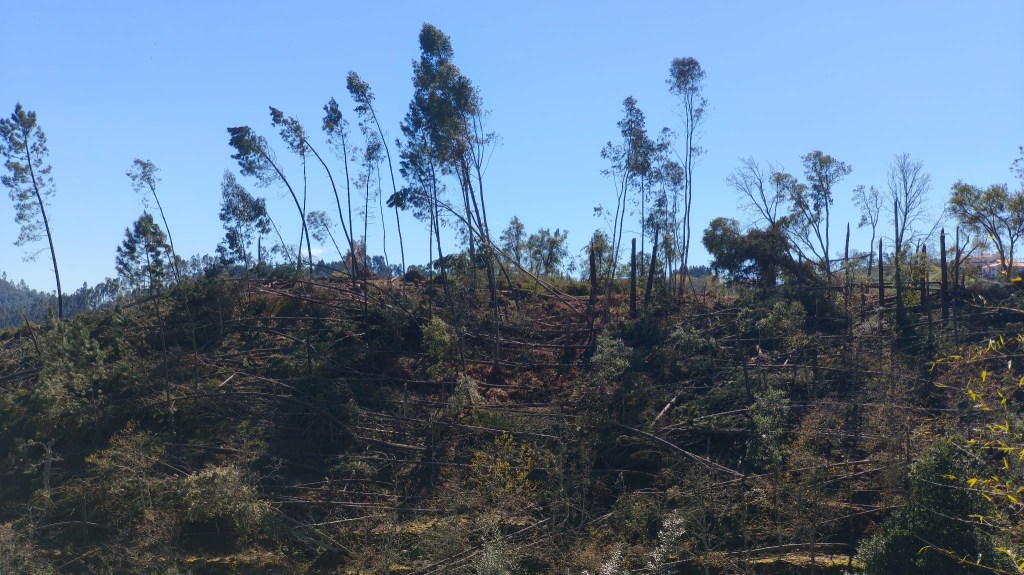
Near Figueró dos Vinhos, we visited the Association of Victims of Pedrógão Grande Fire (AVIPG), where Dina counted us their more recent experiences. The recent “train of storms” had impacted the region severely and we could directly observe the impact at the building’s roof. The chimney of the old building that is in AVIPG’s use had fallen and destroyed a significant part of the roof, forcing the removal of all the furniture outside the main room. Our short conversation with Dina thus took place on foot. The storm’s impact on the building was just a very proximal version of the destruction witnessed in the “forest” all around on the hills.
During our conversation, Dina showed us several artifacts of fire – mugs, glasses, cutlery, pieces of industrial material that were reshaped and remolded by the heat of the fire. As these artefacts were passed from hand to hand, it was impossible not to think, what do these melted objects convey, what do they code? What does their strange materiality do to us? What do these people who keep them in a micro-museum of sorts want to retain with them? What do they want to communicate by showing these molten pieces to people like us, visitors? What do they want to retain with these objects? Can we retain, or rather, what could we better retain, from the experience of such extremity?
The experience brought about this poem:
In this place, the equation was simple: eucalyptus was money.
We wanted money, we wanted much of it and we wanted quickly,
The earth gave us all we wanted, to the extent that we could not move inside money anymore.
There was then nothing but money.
We were using poison to open our path in money.
Now they come and tell us about ungrowing.
Nature does not know how to ungrow.
Money does not know how to not grow.
Ayşem Mert;
Our project website provides the following information on the Portuguese case study:
“The summer of 2017, Portugal faced the worst wildfires in its recent history. On the 17 June 2017 in Pedrógão Grande, 66 people lost their lives, 250 were injured, and over 1000 buildings were destroyed or damaged.
All over Portugal 30.000 fires, some of which were megafires, claimed 540.000 hectares of forestland in the same year, which is 250% above the annual average. This can be connected both to the droughts impacting the region and to the unprecedented fire behaviour, the rate of spread and fireline intensity. More than 120 people were lost in 2017 overall, transforming the wildfires into a human tragedy with political consequences. After the events exposed the vulnerability of the country’s emergency rescue and civil protection structure, the Interior Minister de Sousa resigned.
The Association of Victims of the Pedrógão Grande Fire has been founded in the aftermath of the tragedy. Its mission is to defend the rights and legitimate interests of the people affected by the 2017 Pedrógão Grande fire, to pay tribute to the dead and injured victims, and to promote measures to prevent and avoid the occurrence of similar circumstances in the future.”
Since we have started the project in 2023, I’ve been exposed to more details, more accounts, more reflections of the tragedy that Mali gathered, analysed and presented to us. I’ve heard of other accounts as well. Yet, only when we were walking the terrain did I make sense of some of the details mentioned. I was expecting to gain a deeper understanding of course. That’s why we wanted to go and be there… What I wasn’t expecting, perhaps, is how much of this new ‘understanding’ would be a result of hearing, seeing, smelling, walking and talking with the inhabitants of PGG human and non-human.
I make a list here, and see where it takes me:
- The cork, the oak, and the pine
During our hike, we saw traces of a more recent fire in the forest. At one point, we found ourselves saying: “here is where the fire stopped”. The shift was visible. Around us were mainly cork oak, oak, and pine. We were told that these trees can “repel” fire, or at least resist it differently, but it was still startling to see this distinction materialised in the landscape.
There was something almost pedagogical about the forest at that moment. The trees did not simply illustrate a point about species, fire behaviour, or land management. They made visible the unevenness of vulnerability. They showed that fire does not move through a neutral landscape. It moves through histories of planting, abandonment, extraction, cultivation, and care.
- The eucalyptus
And then there was the eucalyptus: everywhere, insistent, fragrant, invasive, and historically charged.
Spring hikes are good for this kind of thinking. We walked, talked, compared impressions, and told stories from our different lives. At the same time, we consulted apps and websites for what we could not reliably recall or did not yet know. It was during this walk that I learned that the most common eucalyptus in Portugal is Eucalyptus globulus, commonly known as southern blue gum: a tall evergreen tree endemic to southeastern Australia.
It arrived in Portugal in the nineteenth century, initially valued for its capacity to drain wetlands. Over time, however, eucalyptus became part of a wider political-economic assemblage of state, capital, and landscape transformation. Under Salazar’s Estado Novo, with its commitment to (autarky) economic self-sufficiency and strong state intervention in land use, eucalyptus expansion became tied to forestry modernisation. It could be planted on so-called “marginal” or degraded lands; it required relatively little labour; and it promised productivity where more diverse landscapes had been deemed insufficiently profitable. The expansion first took place through state-led afforestation programmes and later through incentives for private landowners. The result was the proliferation of monocultures. And what a monoculture we saw around us!
Eva sensitizes my gaze to how all other trees are surrounded and pushed out by the little saplings of eucalyptus everywhere, occupying the spaces between. Mali reminded us that this was not the “true” form of the eucalyptus tree, which can grow into a large, impressive trunk of considerable height. Later, I learned that these proliferating saplings are often described as “naturalised non-native occurrences”; self-sown eucalyptus that can grow extraordinarily quickly, up to 2.5 m per year, when young.
This made me see the landscape as a historically produced firescape, rather than ‘forest’. The eucalyptus carried within it a history of plantation logics, state planning, rural depopulation, industrial forestry, and the conversion of agricultural and communal lands into productive forest. The result is enclosure of communal lands (baldios) –what inspired Marx, I recall, is the enclosure of the English commons. In Portugal, too, the policy aimed to turn these diverse but less lucrative landscapes into zones of production.
I learn that Eucalyptus was once called ‘green gold’. The phrase is revealing. It condenses the promise of wealth, growth, and national development into the figure of a tree. But in Pedrógão Grande, that promise appears from another angle. Green gold becomes fuel. Productivity becomes exposure. Landscape improvement becomes danger.
The history is striking. Around 1860, Francis Cook, a British merchant and art collector, planted eucalyptus at Monserrate Palace in Sintra, the traditional summer resort of the Portuguese court in the foothills overlooking the Atlantic Ocean north west of Lisbon, over 200 km southwest of where we are. By 1878, the tree “had spread from one end of Portugal to the other.” [1] Cook himself belonged to the world of imperial commerce and elite landscape-making: British trade, aristocratic property, ornamental planting, colonial botanical movement. Plantation, colonisation, and domination precede the expansion of eucalyptus. Fires follow.
The boom of the Portuguese pulp and paper industry from the 1950s to the 1970s intensified this transformation. Eucalyptus became ideal for industrial forestry because of its fast growth (harvest in ~10–12 years; though we heard as short harvests as 7 years), high pulp yield, and ability to thrive in poor soil conditions. But these economic efficiencies had long ecological and social afterlives: rural depopulation, abandoned agricultural land, the replacement of mixed farming systems with industrial monoculture forestry, altered ownership patterns, transformed local ecologies, and intensified fire regimes.
Walking through this landscape, these histories did not feel abstract. They seemed to gather around us in the smell of eucalyptus, in the density of saplings, in the visible contrast between species, in the uneasy, harrowing, haunted beauty of the forest itself.
- The poisonwood tree
On the way back, I started reading The Poisonwood Bible. It begins with Genesis 1:28
“And God said unto them, Be fruitful, and multiply, and replenish the earth, and subdue it: and have dominion over the fish of the sea, and over the fowl of the air, and over every living thing that moveth upon the earth.”
Then Barbara Kingsolver’s first sentence resonated with the feeling I carried from Pedrógão Grande: “Imagine a ruin so strange it must never have happened.” She introduces the Congo, through a walk in the forest. A mother, her four daughters, and her husband, a Baptist preacher, are walking in the forests of the Congo in 1960, on their way to their new home, his new church.
She introduces the Congo through a walk in the forest: a mother, her four daughters, and her husband, a Baptist preacher, on their way to a new home and a new church in 1960. I found myself lingering with that opening because it, too, begins with a landscape that is not merely a setting, but a witness. A landscape marked by faith, empire, extraction, and the impossible innocence of arrival.
“Imagine a ruin so strange it must never have happened. First, picture the forest. I want you to be its conscience, the eyes in the trees. The trees are columns of slick, brindled bark like muscular animals overgrown beyond all reason. Every space is filled with life: delicate, poisonous frogs war-painted like skeletons, clutched in copulation, secreting their own precious eggs onto dripping leaves. Vines stragling their own kin in the everlasting wrestle for sunlight. The breathing of monkeys. A glide of snake belly on branch. A single-file army of ants biting a mammoth tree into uniform grains and hauling it down to the dark for their ravenous queen. And, in reply, a choir of seedlings arching their necks out of rotted tree stumps, sucking life out of death. This forest eats itself and lives forever.” (The Poisonwood Bible, p.1)
Pedrógão Grande is not the Congo, and eucalyptus is not the whole story of fire. But the resonance stayed with me. Some ruins are so strange, so overdetermined, so historically layered, that they are narrated as if they were accidents. As if they simply happened. As if fire arrived from elsewhere. But walking through Pedrógão Grande made it difficult to sustain that illusion. Fire was not only an event that had passed through the landscape. It was also a way of reading the landscape: its plantations and absences, its abandoned fields and enclosed commons, its promises of productivity, its infrastructures of rescue and failure, its grief, and its still-living forms of resistance.
- Anonymous tree / Casa do Tempo
Another image stays with me: the anonymous tree.
Behind the monastery, we visit the Casa do Tempo — the House of Time — a small regional museum devoted to the history, culture, and traditions of the region. They invite us in generously and share their stories with us. The museum is modest, local, careful. It gathers time in the form of objects, memories, images, and gestures of preservation.
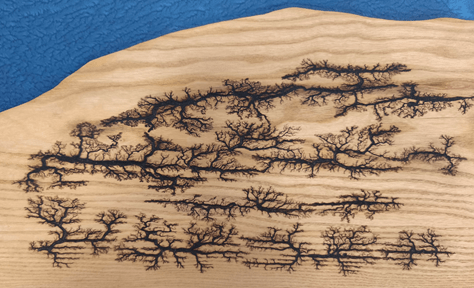
Inside, there is also an exhibition by a local artist. He works with slices of trees — I wish I knew what kind of tree — and burns them using a special technique. The burn marks become patterns. Damage becomes decoration. Fire becomes texture, craft, surface. The pieces are beautiful, in a way. They are also cute, tacky, and uncanny all at once.
I keep thinking about this transformation: a burnt tree turned into an object one can buy; combustion translated into local craft; the trace of fire aestheticised into something pretty enough to take home. There is something tender in it, perhaps even reparative. But there is also something unsettling. The burnt slice becomes a souvenir, commodity, memory-object. It domesticates fire without quite neutralising it.
The anonymous tree sits uneasily within the firescape. It is no longer forest, not quite memorial, not simply art. It is a fragment of landscape made portable. It asks what happens when burned matter is turned into heritage, when destruction becomes design, when a region marked by fire also learns to narrate, display, and sell its traces.
Maybe this, too, is part of living with wildfire: not only prevention, mourning, anger, and adaptation, but also the strange afterlives of burned things. The ways fire enters local economies of memory. The ways it becomes craft, product, story, and décor. The ways it remains uncanny even when made pretty.
- The kale and the water pump
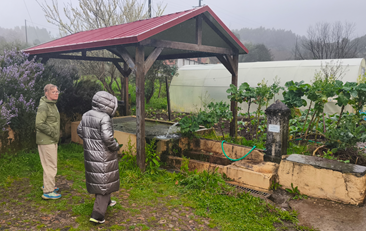
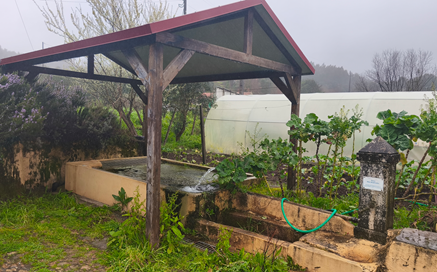
There is also a memorial in Nodeirinho, across from a small water pump where we stop for a while. We cross the narrow street to look at it. We are told that this pump saved more than twenty lives.
I don’t understand how. It is tiny. Technically, how could it have saved so many people? How could something so small stand between life and death, between fire and survival?
Then I notice the little vegetable garden it waters — its original, ordinary purpose. A few square metres in someone’s backyard, full of kale and other produce. So much food growing in such a small plot of land. Not agricultural land in any formal sense. Not productive land according to the logics of scale, efficiency, or modern planning. Just a backyard garden, modest and abundant.
And yet, unintentionally, this small excess of water, this tiny infrastructure of care, became life-saving.
I keep thinking about the randomness of it. How abundant and precarious nature is at the same time. How survival can depend on resources that were never designed as emergency infrastructure: a backyard pump, a vegetable patch, a little water kept in place because someone still cultivated a small piece of land for food.
There is something almost horrifying here for economies of scale. The pump and the garden are inefficient, too small, too local, too ordinary. And precisely because they had not been absorbed into the smooth logics of productivity, they remained available. They had not been removed, rationalised away, abandoned, or replaced. Their very modesty became a condition of survival.
Perhaps this, too, is part of the firescape: the accidental life-saving capacities of small, residual, everyday infrastructures. The things that remain because people still live with land in ways that are not entirely captured by efficiency. A pump for watering kale becomes, in the moment of catastrophe, a refuge. A backyard becomes a threshold between death and survival.
[1] “The Eucalyptus for the West of England”. The Cornishman. No. 16. 31 October 1878. p. 5.


Leave a Reply